


Personal Savings
Certificates of Deposit (CDs)
Have savings you won’t need right away? Put your money to work with a predictable return for a set amount of time.
View Current CD Rates Contact AGCUGrow Your Savings with a Predictable Return
A certificate of deposit (CD), also called a share certificate at a credit union, lets you set aside money for a specific amount of time while earning dividends at a fixed rate.
Unlike a traditional savings account, a CD is designed for money you don’t expect to use during the certificate term. In exchange for leaving those funds on deposit, CDs may offer a higher return than a traditional savings account.
Why Choose an AGCU CD?
Predictable Earnings
Lock in your rate for the certificate term, so you know how your savings will earn.
Competitive Rates
CDs can offer an attractive return when you don’t need immediate access to your savings.
Multiple Term Options
Choose from available certificate terms to find an option that fits your savings timeline.
Federally Insured
Your qualifying AGCU deposits are federally insured by the National Credit Union Administration (NCUA) up to applicable limits.
Monthly Dividends
Dividends on AGCU certificates are compounded and credited monthly.
Savings with a Purpose
Your deposits help AGCU serve members, churches, ministries and businesses through Banking with a Purpose.
The Basics
How Does a CD Work?
Choose an Amount
AGCU CDs have a minimum opening deposit of $1,000.
Choose Your Term
Select from the certificate terms currently available from AGCU.
Earn Dividends
Your certificate earns the disclosed rate during its term.
Reach Maturity
At maturity, decide what you want to do next with your savings.
Understanding Your Return
What Does APY Mean?
APY stands for Annual Percentage Yield. It shows how much an account can earn over a year when compounding is taken into account.
APY makes it easier to compare the earning potential of different savings products and certificate terms.
Is a CD a Good Fit for Your Savings?
A CD may make sense when you have money set aside that you don’t expect to need during the certificate term.
A CD may be worth considering if you:
- Have savings beyond your day-to-day and emergency needs
- Are saving toward a goal with a known timeline
- Want a predictable rate rather than a rate that can change during the term
- Want to reduce the temptation to spend money you’re saving
- Are comfortable leaving the funds on deposit until maturity
Before You Open a CD
Make Sure You Won’t Need the Money Right Away
A CD is different from a traditional savings account because it is intended to remain on deposit for a specific term.
If you withdraw principal before the certificate reaches maturity, an early withdrawal penalty may apply.
Before opening a CD, consider keeping enough money in an accessible savings account for emergencies and other near-term expenses.
CD or Savings Account?
It doesn’t have to be one or the other. The two accounts can serve different jobs in your savings plan.
Certificate of Deposit
Designed for money you can leave on deposit for a set period.
Think: future purchases, planned expenses and savings you won’t need immediately.
Traditional Savings
Designed to keep money available when you need it.
Think: emergency funds, short-term goals and savings you may need to access.
Savings Strategy
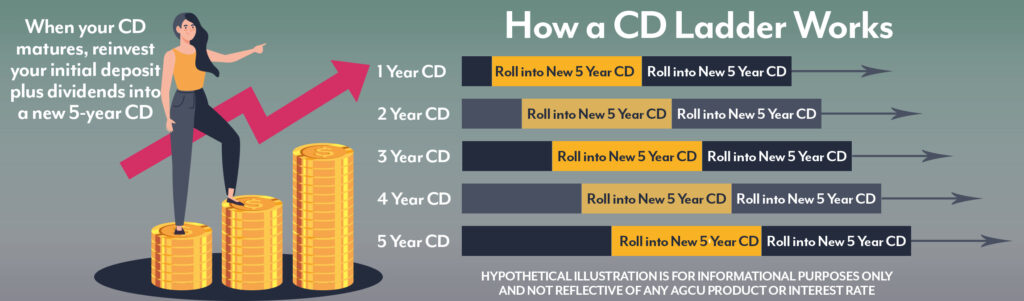
Want More Flexibility? Consider a CD Ladder
A CD ladder divides your savings among several CDs with different maturity dates instead of putting all of the money into one certificate.
As each CD matures, you can use the money or reinvest it into another certificate. Over time, this creates regular maturity dates while allowing more of your savings to remain invested.
At the End of Your Term
What Happens When Your CD Matures?
Your CD’s maturity date is the end of its agreed-upon term. At AGCU, certificates automatically renew unless you choose another option.
Good to Know
You Have a 10-Day Grace Period
After your CD matures, you have a 10-calendar-day grace period to make changes or withdraw your funds without an early withdrawal penalty.
Your Options at Maturity
Renew Your CD
Keep your savings in a certificate and continue earning dividends. Review current AGCU rates and available terms before your maturity date.
Choose Another Account
Move some or all of your funds into another AGCU account, such as checking, savings or a money market account, depending on your needs.
Withdraw Your Funds
You may withdraw some or all of your funds during the 10-day grace period without an early withdrawal penalty.
If you take no action, your certificate will automatically renew according to the terms of your account. The rate at renewal may be different from the rate you earned during your previous term.
Plan Ahead
Is Your AGCU CD About to Mature?
You don’t have to wait until maturity day to decide what comes next. Take a look at current rates and think about how you plan to use the money.
Do you still want to keep it set aside? Will you need easier access to some of it? Would another CD term better fit your plans? A little planning before maturity can make the decision easier.
Learn More
New to CDs?
We break down terms, APY, maturity, early withdrawals and CD ladders in our guide to certificates of deposit.
Read: What Is a CD and How Does It Work?Put Your Savings to Work
Find an AGCU CD That Fits Your Goals
Start with as little as $1,000 and choose from available certificate terms and rates.
View Current CD Rates Contact AGCUBanking with a Purpose.
APY = Annual Percentage Yield. Minimum opening deposit and certificate terms may vary by product or promotion. An early withdrawal penalty may apply. Rates and terms are subject to change. Membership eligibility requirements apply. Federally insured by NCUA.