


Financial Wellness
CD Laddering: Build Your Savings One Rung at a Time
Discover how combining Share Certificates with different maturity dates can help you balance predictable earnings with planned access to your savings.
What if you could put your savings to work without having every dollar tied up until the same date? That’s the idea behind a CD ladder: a simple strategy that divides your savings among Share Certificates with different maturity dates.
At Assemblies of God Credit Union (AGCU), Share Certificates—also known as Certificates of Deposit or CDs—are regularly available in 3, 6, 12, 18, 24, 36, 48, and 60-month terms. We also often offer promotional certificate specials. Those options give you several ways to create a ladder around your own timeline.
What Is a CD Ladder?
A CD ladder is a savings plan made up of two or more Share Certificates that mature at different times. Instead of placing all your money into one certificate, you spread it across several terms. Each maturity date is another opportunity to withdraw the money or reinvest it.
Imagine a ladder: each rung is a certificate, and each rung comes due on its own schedule. You can choose short-term rungs, long-term rungs, or a combination of both.
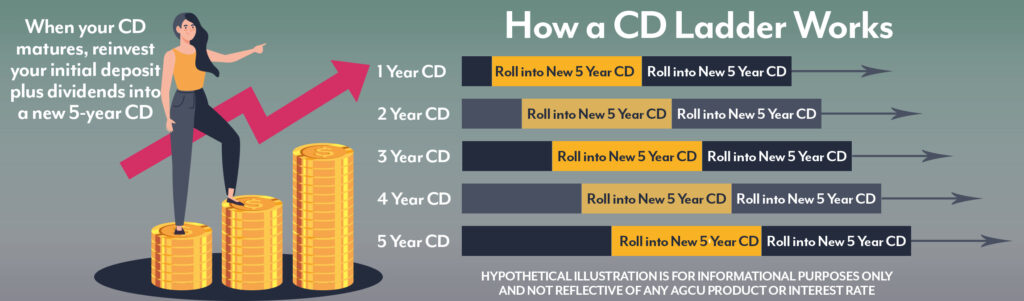
The big idea: You can build a long-term savings plan while giving yourself scheduled opportunities to access portions of your money without an early withdrawal penalty.
How Does CD Laddering Work?
Suppose you have $8,000 you can set aside. Instead of opening one certificate, you divide it into four certificates with terms AGCU regularly offers:
| Certificate | Deposit | Term | Maturity |
|---|---|---|---|
| Rung 1 | $2,000 | 12 months | Year 1 |
| Rung 2 | $2,000 | 24 months | Year 2 |
| Rung 3 | $2,000 | 36 months | Year 3 |
| Rung 4 | $2,000 | 48 months | Year 4 |
When the first certificate matures after 12 months, you can use the money or reinvest it in a new 48-month certificate. The next year, your original 24-month certificate matures, giving you another decision point.
If you continue renewing each maturing rung into a new 48-month certificate, you can eventually have four 48-month certificates with one maturing each year.
You still have funds committed for their individual terms, but you are no longer waiting for your entire savings balance to mature at once.
Remember: These are illustrative deposits, not a projection of earnings. Actual dividends depend on each certificate’s rate, compounding, and account terms. Minimum opening deposits also apply.
Why Do People Build CD Ladders?
Scheduled Access to Savings
When one certificate matures, you have an opportunity to access that portion of your money without an early withdrawal penalty. A ladder can be especially helpful when you have expenses planned for different years.
Predictable Dividend Earnings
Traditional fixed-rate Share Certificates generally keep their contracted dividend rate through maturity. That makes them useful for planning, even though each rung may have a different rate based on its term and opening date.
Less Pressure to Predict Interest Rates
Interest rates move up and down. With a ladder, you don’t have to make one decision about your entire savings balance.
If rates rise, a maturing rung may be reinvested at a higher available rate. If rates fall, your existing fixed-rate certificates generally keep their original rates until maturity.
A Savings Plan with Built-In Checkpoints
Every maturity date is a natural time to review your goals. Do you need the funds? Would you rather renew? Has your timeline changed? A ladder gives you recurring opportunities to ask those questions.
Three Ways to Build Your CD Ladder
1. Short-Term Ladder: More Frequent Maturity Dates
If you want shorter commitments, consider a combination of 3, 6, 12, and 18-month certificates.
For example, you could place $1,500 into each of four certificates, provided each deposit meets the current minimum. You would then have scheduled maturity opportunities over the next year and a half.
A short-term ladder may appeal to savers who expect to revisit their goals relatively soon. Keep in mind that shorter terms do not always offer the highest APYs.
2. Long-Term Ladder: One Rung Per Year
A traditional five-rung ladder can use AGCU’s 12, 24, 36, 48, and 60-month certificates. The original certificates mature one year apart.
If you renew each maturing rung into a new 60-month certificate, you can eventually hold five 60-month certificates, with one scheduled to mature every year.
This approach combines longer certificate terms with recurring annual maturity opportunities. It does not guarantee that longer terms will pay more than shorter ones.
3. Goal-Based Ladder: Match Your Maturity Dates to Your Plans
Maybe you’re saving for a vacation in six months, a vehicle purchase in two years, and home improvements in four years.
A combination of 6, 24, and 48-month certificates could put those maturity dates closer to the times you expect to need the funds.
With a goal-based ladder, you may not intend to renew every certificate. The purpose is to make money available when you plan to use it.
What About AGCU’s Special-Rate Certificates?
AGCU often offers promotional Share Certificates with special rates or terms. These can sometimes fit neatly into a ladder—even when the promotional term doesn’t match the rest of your schedule.
For example, a promotional certificate that matures between two existing rungs might give you another useful access point. But a special APY isn’t the only thing to consider.
- Maturity date: Will the money become available when you need it?
- APY: How does it compare with other currently available terms?
- Minimum deposit: Does the offer fit your available savings?
- Early withdrawal penalty: What happens if your plans change?
- Renewal provisions: What happens when the promotional term ends?
Helpful tip: Don’t choose a rung based on APY alone. The right maturity date can be just as important as the rate when you’re building a ladder around your goals.
Because rates and promotions change, we recommend checking AGCU’s current Share Certificate rates and terms before making a decision.
What Happens When a Certificate Matures?
At maturity, you can review your options. Depending on the certificate’s terms and current requirements, you may be able to withdraw the funds, reinvest them into a new certificate, select a different term, or divide the proceeds between savings and spending.
Pay attention to your maturity notice, automatic renewal provisions, and any applicable grace period. Some certificates renew automatically unless you give instructions within the permitted timeframe.
How Much Do You Need to Start?
You don’t need to begin with a five-rung ladder. Two or three certificates can be a useful starting point, and you can add rungs as your savings grow.
The total amount you need depends on the minimum opening deposit for each certificate you choose.
Review AGCU’s current rates and minimum deposit requirements before dividing your funds.
CD Ladder or Regular Savings Account?
A CD ladder and a regular savings account can work together. Certificates can help organize money you won’t need immediately, while a savings account can keep emergency funds readily available.
| Feature | CD Ladder | Savings Account |
|---|---|---|
| Access | Scheduled maturity dates; early withdrawal penalties may apply | Generally more readily accessible |
| Dividend Rate | Typically fixed for each certificate term | Generally variable |
| Best Use | Funds you can set aside for defined periods | Emergency savings and everyday flexibility |
Keep your emergency fund accessible. A ladder is not a replacement for savings you may need immediately for unexpected expenses.
Are CD Ladders Federally Insured?
Eligible Share Certificate deposits at AGCU are federally insured by the National Credit Union Administration (NCUA), subject to applicable limits and ownership rules.
NCUA share insurance generally covers eligible deposits up to $250,000 per member, per federally insured credit union, for each applicable ownership category.
Opening several certificates in the same ownership category does not automatically multiply that coverage. Eligible balances in the same ownership category are generally combined when calculating insurance coverage.
Learn more at NCUA.gov.
Is a CD Ladder Right for You?
A CD ladder may be worth considering if you want predictable earnings, have money you can set aside for defined periods, and appreciate having regular opportunities to review your savings plan.
It may be less appropriate if you expect to need most of the money on short notice.
The best ladder is not necessarily the one with the most rungs or the longest terms. It’s the one that works with your savings goals and your timeline.
Save with a Plan—and a Purpose
CD laddering isn’t about trying to outguess interest rates. It’s about making thoughtful choices with money you’ve worked hard to save.
Start with your goals. Choose maturity dates that make sense. Then revisit your plan as each certificate comes due. Sometimes the smartest savings strategy is simply one you can understand, manage, and stick with.
Ready to Build Your CD Ladder?
With regular terms from 3 to 60 months and occasional promotional specials, AGCU can help you explore Share Certificate options that fit your savings goals.
Or call 866-508-2428.
Banking with a Purpose.
Important Information: This article is for educational purposes. Examples are hypothetical and do not represent actual AGCU rates or guaranteed future offers. Certificate availability, minimum deposits, dividend rates, APYs, promotional terms, early withdrawal penalties, and renewal conditions are subject to current AGCU agreements and disclosures. Fees or early withdrawals may reduce earnings. Federally insured by NCUA.